
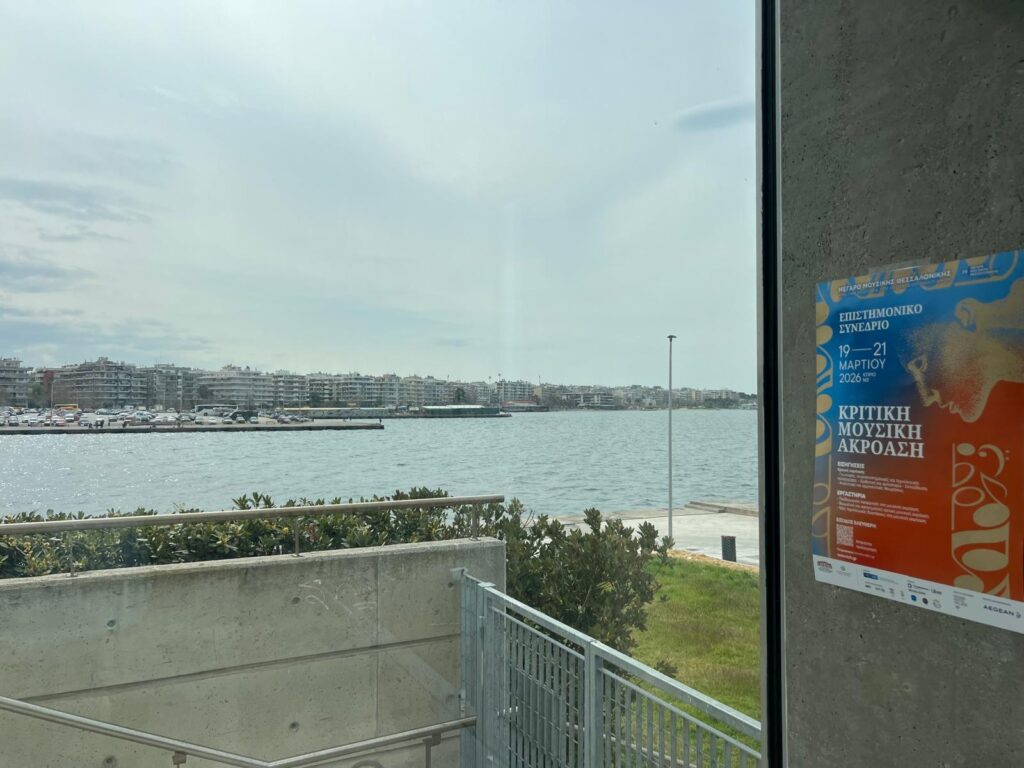
Last week I attended a conference in Thessaloniki that I will not forget quickly. The Intellectual Ear, conceived and presented by Dr Aikaterini Syrrakou and organised by the TCH, brought together researchers and clinicians to explore the psychological and neuroscientific dimensions of acoustic experience. The organisation was precise and the concept sharp. From the first session, it was clear this was not a standard academic gathering.
The keynote was delivered by Professor Jody L. Kerchner, ISME President-Elect and Professor of Music Education at the Oberlin College and Conservatory of Music in the United States. Professor Kerchner has spent decades studying how children and adults respond to music listening, and her work on the psychosocial impact of musical participation in community and clinical settings is among the most cited in the field. Her address set the tone for the day: music is not background. It is a primary language of the nervous system.
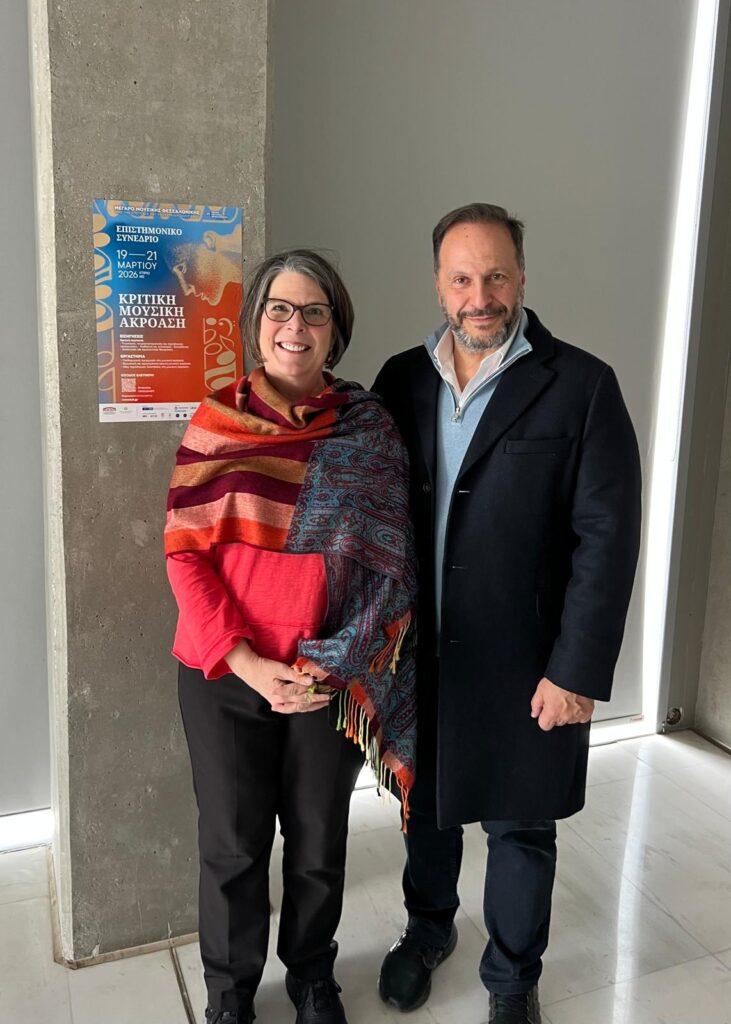
Dr Nikos Chatzibalassis with ISME President-Elect Professor Jody L. Kerchner, The Intellectual Ear, Thessaloniki.
Dr Christiana Adamopoulou, who holds her PhD in music therapy from the Ionian University and trained at Anglia Ruskin University in Cambridge, presented her clinical research on music and ADHD. Dr Adamopoulou has twenty years of clinical experience working with children across mainstream and special needs settings, including work at Agia Sofia Children’s Hospital in Athens. Her presentation was precise and grounded. What stayed with me was not just the data, but the clarity of the mechanism she described: music as a tool for regulating attention, not as support activity, but as a clinical instrument in its own right.
Dr Christina Anagnostopoulou, Associate Professor in Music Informatics and Cognition at the National and Kapodistrian University of Athens and Director of the Music Cognition, Computation and Community Laboratory, framed music audition as a creative psychoemotional process. Her academic background spans music, artificial intelligence, and cognitive science. She has worked at the universities of Edinburgh, Glasgow, and Queen’s University Belfast, and her current research examines the relationship between music, language, and emotional processing. This sits close to something I return to constantly in clinical work: what we hear shapes how we feel, and how we feel shapes what the body does next.
Dr Efthimios Papatzikis, Professor of Educational Neuroscience at the Canadian University Dubai and currently also affiliated with Oslo Metropolitan University, spoke about neuroplasticity and music. His research career has taken him through Harvard University, UCL, the University of Geneva, and the Human Brain Project at EPFL in Switzerland. He is also a former career violinist, which gives his neuroscience work a particular quality: he is not studying music from the outside. His published work in the Annals of the New York Academy of Sciences on quality standards in music and neuroplasticity research is the kind of evidence that the integrative medicine field needs to take seriously. What he presented in Thessaloniki confirmed something I have long believed: auditory experience does not just influence mood. It reshapes neural architecture. That is not a metaphor. It is a measurable, documented fact.
I left Thessaloniki with new colleagues and a sharper sense of where music science and complementary health meet. At the Academy of Humanopathy, we have always understood that the human being is one system. The nervous system, emotional life, and the body do not operate in separate departments. What this conference confirmed is that music belongs inside that understanding, not on its edge.